27 July 2017
Connect Vermeer
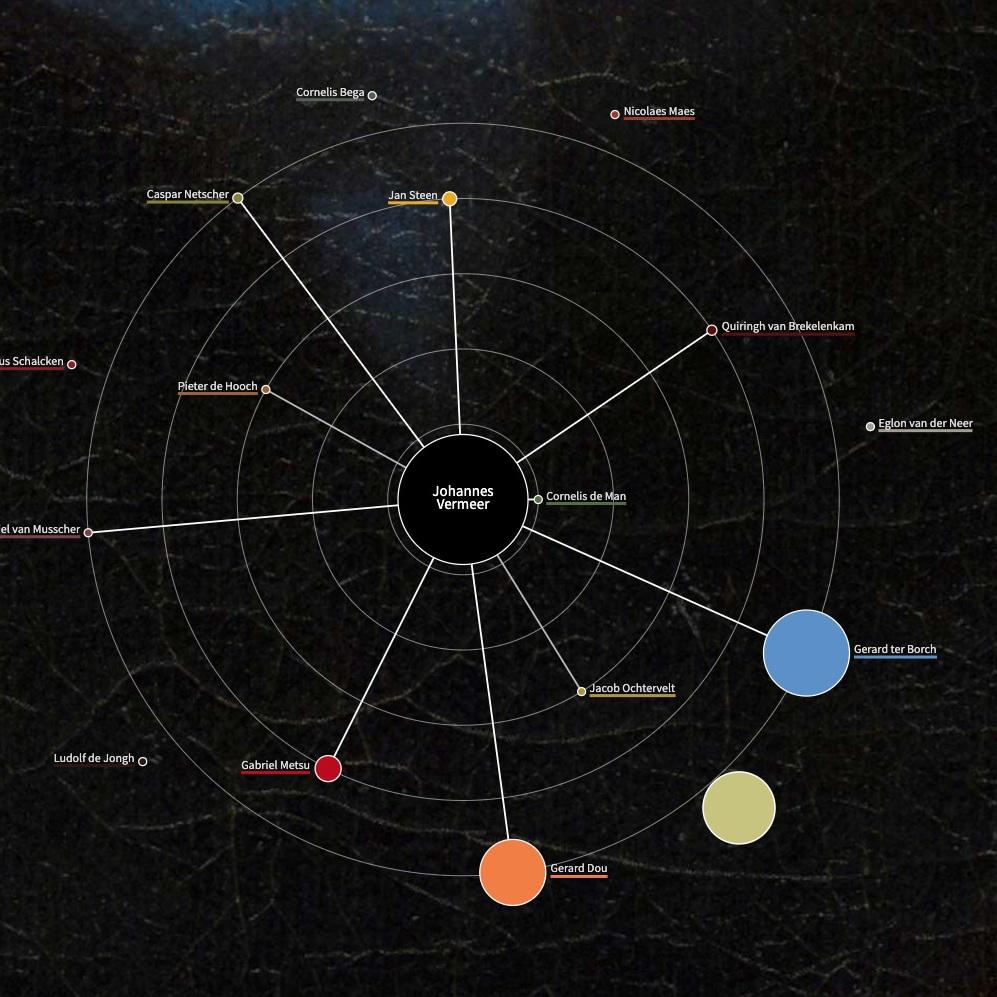
I worked for nearly two years at Noho, a Dublin digital agency specialising in interactive experiences. One of the more interesting projects we worked on was a digital research platform to accompany the National Gallery of Ireland's exhibition Vermeer and the Masters of Genre Painting: Inspiration and Rivalry. The research underpinning the exhibition had been conducted by the National Gallery of Ireland in collaboration with the Netherlands Institute for Art History (RKD), and their central finding was that far from being a solitary genius, Vermeer was in fact one of seventeen Dutch genre painters working in close awareness of each other across the 17th century, drawing on, competing with, and consciously responding to one another's output.
The challenge was to make that web of relationships legible and explorable. Art historians and computer scientists from the universities of Leipzig and Regensburg worked on an informal data model to map these connections and these were encoded in a formalised ontology using the OWL Web Ontology Language and the CIDOC CRM top level model, following an event-centred schema. The data represents not just which works were connected but the confidence and nature of each relationship. Our job was to turn this data model into something a museum visitor could navigate both via a touchscreen in the exhibit or via the project website.
Each connection between paintings was classified along two axes: the probability of the relationship (on a five-point scale from 'certainly' down to 'perhaps') and the strength of the connection across five categories, ranging from works with only faint compositional echoes up to direct copies and pastiches. Numeric weightings were assigned to both axes and multiplied together for each link, with the results summed across all links between two artists to produce a single relationship score. This gave the visualisation a data-driven basis for the relative sizes of nodes and the weights of edges in the network, ensuring that a highly confident, strongly derivative connection carried far more influence than a speculative or superficial one.
Led by an excellent Noho design vision, we built the experience as a journey from the macro to the micro. The frontend was built on top of the popular data visualisation framework, d3.js with the entry point being a network view of all seventeen artists — a solar system where the user picks an artist to sit at the centre and watches the others arrange themselves by connection strength. The size of each node reflects that artist's overall influence across their career, thereby making it simple to see who shaped the period and who influenced a particular colleague. From there, users can drill into a single painter's career and trace how the influence of their work rose and fell over time. Deeper still, they can examine a single painting and discover its artistic ancestry and its downstream impact on others. At the finest level, two specific works can be placed side by side, with high-resolution images that zoom and pan to allow direct comparison of composition, motif and technique.
In April 2018 the Connect Vermeer project was nominated for a GLAMI award.